Summary – How to Test for Argon Gas in Windows: Ensuring Quality in Insulated Glass
- Why it matters:
- IGUs filled with argon or krypton provide better thermal insulation.
- Gas leakage over time reduces efficiency, increases energy costs, and impacts sustainability.
- The 2008 study:
- Introduced a DC electrical discharge method for measuring argon in double-pane windows.
- Achieved ~5% accuracy at moderate to high gas levels.
- Advantages: non-invasive, sensitive, adaptable for manufacturing.
- Limitations: requires lab conditions and spectrometers, not suitable for field testing.
- Sparklike’s solution:
- Sparklike Laser Devices use Tunable Diode Laser Absorption Spectroscopy (TDLAS).
- Independent testing (ift Rosenheim) shows results within ±2% of gas chromatography.
- Benefits:
- Portable and easy to use on-site.
- Non-destructive testing – no damage to IGUs.
- Works in production, installation, and maintenance phases.
- Suitable for double and triple glazing.
- Impact across the IGU lifecycle:
- Manufacturing: verifies proper gas filling and compliance.
- Installation: ensures units meet specifications after transport/handling.
- Maintenance: detects gas loss early to maintain efficiency.
- Conclusion:
- While lab-based methods like DC discharge offer insight, Sparklike provides a proven solution.
- Enables reliable quality control, reduces energy consumption, and supports sustainable construction practices.
Insulating glass units (IGUs) are critical for maintaining energy efficiency in modern buildings. Filled with inert gases like argon or krypton, they offer superior thermal insulation compared to standard air-filled units. However, maintaining optimal gas concentration is vital for their performance, and testing for it without damaging the unit has long been a challenge for the industry.
Interest in non-destructive gas measurement is not new. A 2008 study, Nondestructive Method of Measuring Relative Concentration of Gases in Double-Pane Windows, explored using DC electrical discharge to test for argon gas in windows — an early sign of how the industry has worked toward solving this problem. Since then, measurement technology has moved well beyond lab-based methods. Sparklike’s devices apply this same non-destructive principle in a form built for real-world use, offering precise, on-site methods to test for argon gas in windows and making them a practical choice for quality control and maintenance across the IGU lifecycle.
The Importance of Measuring Gas Concentration of an IGU
The thermal performance of IGUs depends heavily on the type and concentration of the gas filling. Over time, inert gases like argon can escape through sealant degradation, reducing insulation efficiency. This not only increases energy costs but also compromises the environmental sustainability of buildings. Key challenges include:
- Gas Migration: Argon and krypton can leak faster than air fills the unit, leading to reduced pressure and insulation effectiveness.
- Quality Control Needs: Manufacturers and installers need reliable methods to test for argon gas in windows and verify gas fill rates, especially since visual inspection cannot reveal gas concentration issues.
- Compliance and Warranty Exposure: Gas concentration is directly tied to the thermal performance values manufacturers declare and warranty. Standards such as EN 1279-3 set requirements for gas fill rates, and units that fall short — even without any visible defect — create compliance risk and potential warranty claims down the line. Without measurement, this risk is invisible until it surfaces as a field complaint.
The Study: Using DC Electrical Discharge for Gas Measurement
The study introduces a DC electrical discharge method to test for argon gas in windows. By analyzing the emission spectra from excited states of gases, it identifies relative concentrations with 5% accuracy for moderate to high gas levels.
Highlights of the Technique:
- Non-Invasive: Requires no dismantling of IGUs, preserving structural integrity.
- High Sensitivity: Measures argon concentration down to 5%.
- Simple Adaptation: Minor modifications, such as wire insertion during manufacturing, make it feasible for wide-scale adoption.
Despite its potential, the method requires controlled laboratory conditions and equipment like spectrometers, which might limit field applications.
How Sparklike Bridges the Gap
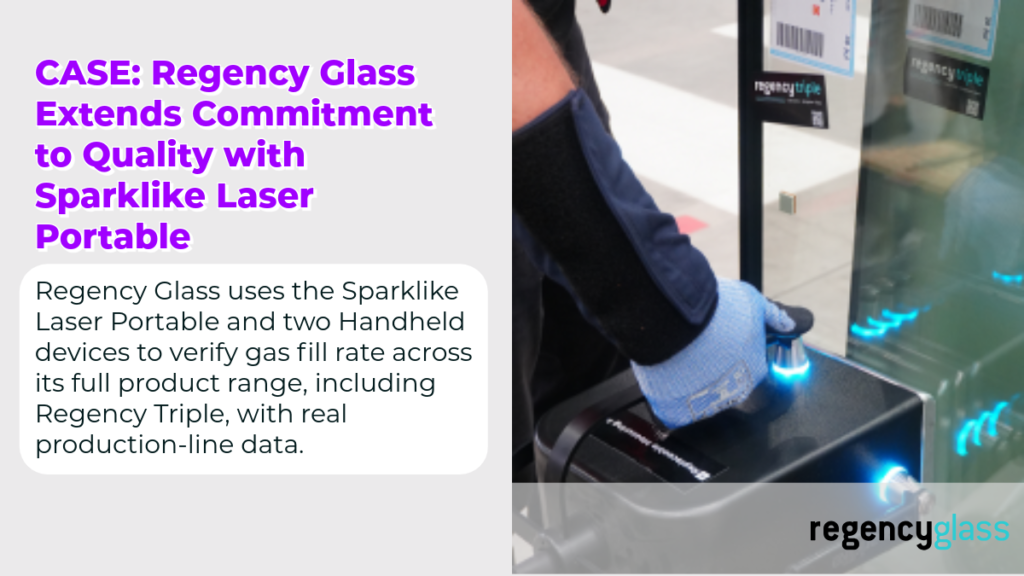
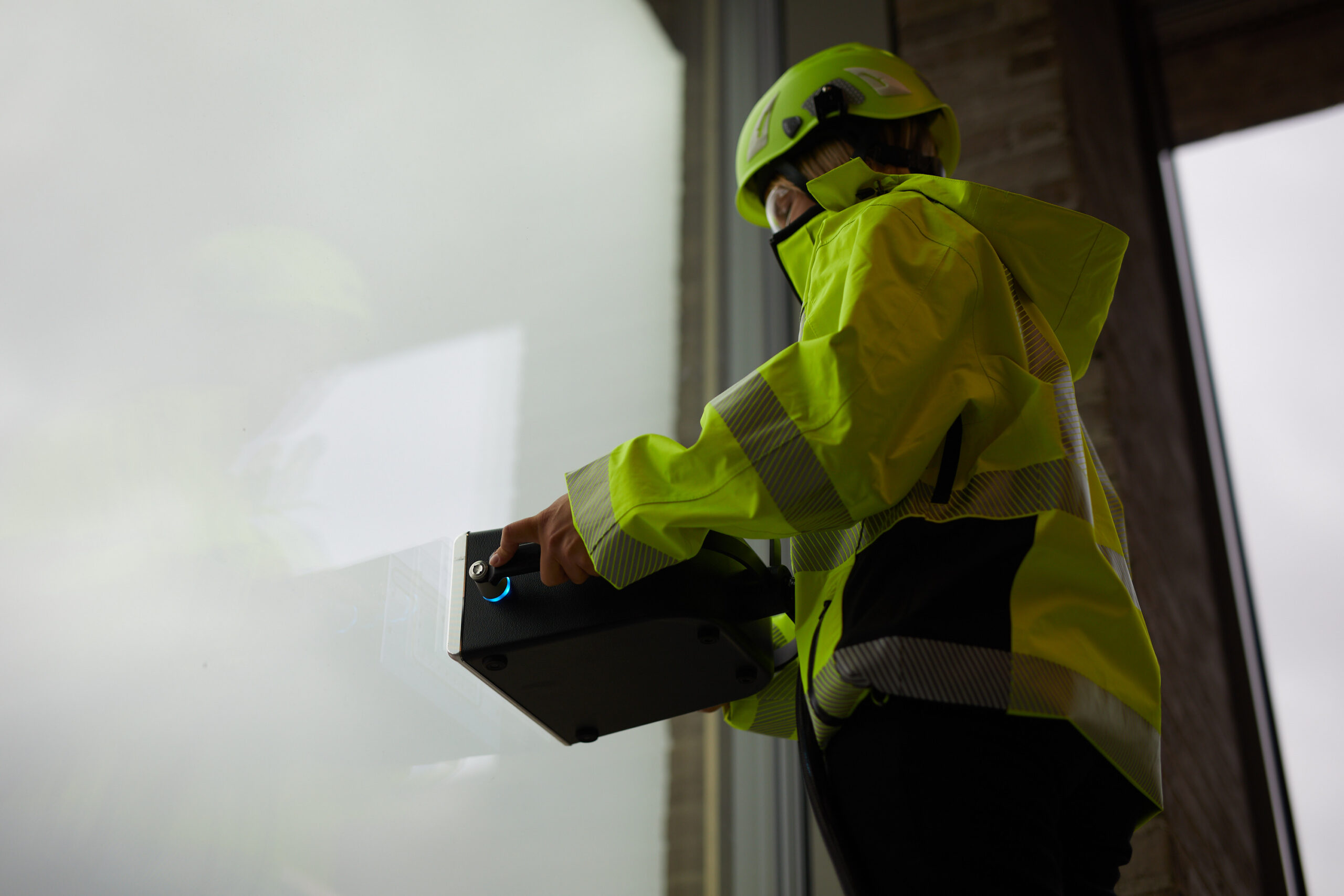
While the DC electrical discharge method is innovative, Sparklike offers a practical and portable solution for real-world applications. Devices like the Sparklike Laser Portable™ use Tunable Diode Laser Absorption Spectroscopy (TDLAS) to test for argon gas in windows with high precision and ease of use. According to independent ift Rosenheim Test Report both Sparklike Handheld and Sparklike Laser Portable 2.2 results are within ± 2 % compared to gas chromatography which makes them highly accurate.
Advantages of Sparklike Devices:
- Field Usability: Compact and portable, suitable for on-site measurements.
- Non-Destructive Testing: Measures gas levels without compromising IGU integrity.
- Versatile Applications: Suitable for both manufacturing and post-installation quality control.
- Accuracy: Reliable measurements, critical for assessing aging IGUs and also the overall quality of insulating glass units.
Why Measurement Matters More Than Visual Inspection
Signs like seal condensation, fogging, or glass bowing are useful indicators of gas loss but they are lagging indicators. By the time these are visible, the gas fill has typically already dropped well below functional levels, and the unit has, in effect, already failed. For manufacturers and installers, that means the issue surfaces only after it has become a customer complaint or a warranty case.
Non-destructive gas measurement moves detection upstream. Testing during production catches fill errors before units leave the factory. Testing after installation confirms that transport and handling haven’t compromised the seal. Testing during maintenance identifies slow leakage while it’s still a minor, correctable issue, not a failed unit. In each case, measurement replaces guesswork with a verifiable number, at the point where something can still be done about it.
Read: Visible vs. Invisible IGU Defects: Why Visual Inspection Alone Is Not Enough
The Role of Gas Measurement in the IGU Lifecycle
Accurate gas measurement is vital throughout the IGU lifecycle:
- Manufacturing: Verifies proper gas filling during production, ensuring compliance with thermal performance standards and functioning of gas fill machinery — reducing the risk of shipping non-compliant units and the rework or claims that follow.
- Installation: Confirms that IGUs meet specifications after handling and transportation, giving installers documented proof of gas fill rate before a project is signed off — useful evidence if performance is ever questioned later.
- Maintenance: Identifies gas leakage early, allowing timely repairs or replacements to maintain energy efficiency, protect building performance claims, and avoid the reputational cost of a visible failure reaching the building owner.
By adopting tools like Sparklike devices provides an answer on how to test for argon gas in windows, insulating glass professionals can ensure the longevity and performance of IGUs, reducing energy consumption and environmental impact.
How Do You Test for Argon Gas in Windows?
The most reliable answer, for both new production and units already in the field, is non-destructive laser-based measurement. Unlike lab methods such as DC electrical discharge, which require dismantling context, spectrometers, and controlled conditions, tools like Sparklike Laser Portable™ and Sparklike Handheld Nova™ deliver gas concentration readings on-site, within ±2% of gas chromatography, without opening the unit. That combination of accuracy and field usability is what has made non-destructive measurement the practical standard for the industry, covering the full lifecycle from manufacturing QC to post-installation verification to ongoing maintenance.
Conclusion: Elevating IGU Performance
The study highlights the potential of methods to the question how to test for argon gas in windows and measure gas concentration in IGUs. While techniques like DC electrical discharge offer valuable insights, Sparklike provides a proven solution for the building industry. With its innovative devices, Sparklike empowers manufacturers, installers, and building owners to uphold IGU quality, contributing to sustainable construction practices.
Want to get a personalized quote, contact Sparklike Sales
Source:
Sergeyev, A., & Borysow, J. (2008). Nondestructive method of measuring relative concentration of gases (e.g. argon) in double-pane windows. Sensors and Materials, 20(3), 123–130.