Gas fill of an insulating glass unit (IGU) is invisible. Once an IGU is sealed, there is no visual indication of whether the cavity contains the correct concentration of argon or krypton. The only way to verify it is to measure and the only way to prove it is to document.
For manufacturers supplying markets with growing requirements for quality documentation, warranty backing, and compliance with standards such as EN 1279-3 or ASTM E2649, measurement alone is no longer sufficient. The question is not just what the gas fill percentage was, but which unit was measured, when, by which device, and on which production line.
Read more:
Key Takeaways from EN 1279-3 2018
ASTM E2649-20 Explained: Determining Argon Concentration in Insulating Glass Units (IGUs)
The Documentation Problem
Quality deviations in insulating glass are mostly visible. Scratches, sealant inconsistencies, and spacer alignment can all be detected by eye. Gas content is different. Read our previous blog Why Visual Inspection Alone Is Not Enough.
Customers increasingly request proof of gas fill, particularly for high-specification projects where declared thermal values depend on it. Internal audits require records that can be traced back to specific production batches. Warranty investigations need timestamped measurement data linked to individual units. Without a structured documentation system, this information either does not exist or exists only in handwritten logs that are difficult to search, share, or audit.
The documentation problem is not a measurement problem but a traceability problem.
Linking Measurements to Individual Units
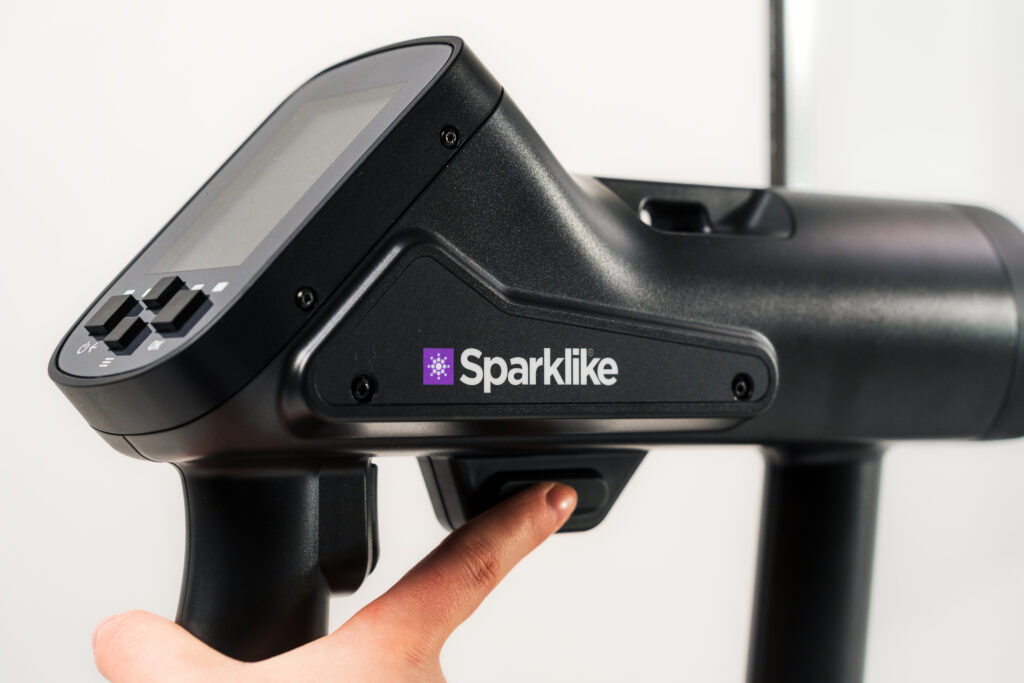
Sparklike Handheld NOVA™ supports QR code and barcode scanning directly on the device. Before taking a measurement, the operator scans the code on the insulating glass unit using the built-in scanner. That code, which may contain the unit’s serial number, glass type, production line identifier, or any other relevant information, is automatically attached to all subsequent measurement results.
This creates a direct link between the measurement record and the individual insulating glass unit. Each stored entry includes the scanned tag, the gas concentration result, a timestamp, the device serial number, and any error or limit notifications. The result is a structured, unit-level measurement record that requires no manual data entry.
For production lines that already use QR or barcode labelling for other quality control purposes, integrating gas measurement into the same system adds traceability without adding administrative burden.
Supported code formats include Code 128, QR Code, and Data Matrix.
Wireless Data Transfer in Practice
Manual logging introduces risk. Transcription errors, missing entries, and illegible handwriting are well-documented sources of quality record failures. When measurement data must be copied from a device display into a spreadsheet or paper form, the record is only as reliable as the person copying it.
Handheld NOVA transfers measurement data wirelessly to the Sparklike Handheld Nova™ web application at nova.sparklike.com. The data downloads directly into the browser — no cables, no manual export, no intermediate files. Because existing records are deduplicated automatically, downloading from the same device multiple times does not create duplicate entries.
The web application stores all downloaded records in the browser’s local memory and makes them immediately available for review, filtering, and export. A QA manager reviewing results from the previous shift does not need access to the device, only access to the computer where the data was last downloaded.
Eliminating the manual transcription step removes the most common source of documentation error without requiring any change to the measurement process itself. Read more about what the web application makes visible in IGU Gas Fill Trends: How to Turn Measurement Data into Production Decisions.
Compliance and Market Requirements
EN 1279-3 specifies requirements for gas fill verification in insulating glass units supplied to European markets. It defines minimum concentration thresholds and requires that gas fill be verified as part of the production process. Documented measurement records support conformity declaration and factory production control requirements under this standard.
ASTM E2649-20, the Standard Test Method for Determining Argon Concentration in Sealed Insulating Glass Units Using Spark Emission Spectroscopy, defines the test method itself. Sparklike Handheld NOVA™ operates on this principle — plasma emission spectroscopy — and measurement data generated by the device is directly relevant to compliance with this standard.
For manufacturers supplying both European and North American markets, having a structured record of gas fill measurements tied to individual units and production timestamps provides a practical foundation for meeting documentation requirements in both contexts.
Gas Measurement as Part of Quality Control
A measurement that cannot be traced to a specific unit, a specific time, or a specific production context has limited value beyond the moment it is taken.
QR-linked, timestamped, wirelessly transferred measurement records change that. They allow manufacturers to answer the documentation questions that arise during audits, warranty claims, and customer reviews, not by reconstructing records after the fact, but because the records were created as part of the normal measurement workflow. For a closer look at how measurement modes affect result quality before data reaches the documentation stage, read Sparklike Handheld NOVA™ Measurement Features: Single and Multisample Modes Explained.
Learn more about Sparklike Handheld Nova™
Visit the Sparklike Handheld Nova™ product page for full technical specifications, or download the brochure to share with your team.